The temperature had dropped to 14° below zero, and frost covered every window of the passenger cars.
Inside, Lieutenant Commander Teeshi Yamamoto pressed his face against the frozen glass, watching the endless white landscape roll past.
He had expected many things when he surrendered to American forces in the Aleutian Islands 6 months earlier.
Interrogation, hard labor, perhaps even execution.
But he had never imagined snow like this, stretching as far as the eye could see.
As the train shuddered to a stop, Yamamoto turned to his fellow officers and whispered words that would prove tragically ironic.
Whatever happens here, we must die with honor.
What these men could not have known was that their deeply held beliefs about enemy treatment, shaped by years of military indoctrination were about to collide with a reality so unexpected that it would fundamentally transform their understanding of the conflict they had been fighting.
The prisoners filed off the train in formation, their breath forming clouds in the freezing air.
Most wore only the tropical uniforms they had been captured in, supplemented by whatever blankets American forces had provided during their journey across the Pacific.
Yamamoto noticed that the American guards waiting on the platform carried weapons, but their faces showed none of the contempt he had been trained to expect.
Instead, they looked almost concerned as they watched the shivering prisoners descend into the bitter Wisconsin cold.
This way, gentlemen, called out Captain Robert Henderson, the camp's liaison officer.
He spoke through an interpreter, a Japanese American sergeant named Henry Tanaka.
We have warm buildings waiting.
As they marched through the camp gates, Yamamoto took careful note of everything.
The barbed wire fences stood 12 ft high with guard towers positioned every 200 yd.
Machine gun imp placements were visible at strategic points.
This was clearly a secure facility.
But something puzzled him.
The guards in the towers were wearing heavy coats and seemed more focused on staying warm than watching the new arrivals with hostility.
The prisoners were led to a series of wooden barracks, each heated by coal burning stoves that filled the rooms with blessed warmth.
As the men crowded around the stoves, rubbing their frozen hands, American soldiers brought in heavy wool coats, thick socks, and insulated boots.
Yamamoto watched his men's faces as they received these items.
Confusion was written across every expression.
In the Japanese military, they had been taught that prisoners were treated as less than human, unworthy of even basic consideration.
"Why are they giving us these things?" whispered Enen Hiroshi Nakamura, a young pilot who had been shot down over Atu Island.
What do they want from us?
I do not know, Yamamoto replied quietly.
But accept nothing as kindness.
This may be a trick to make us lower our guard.
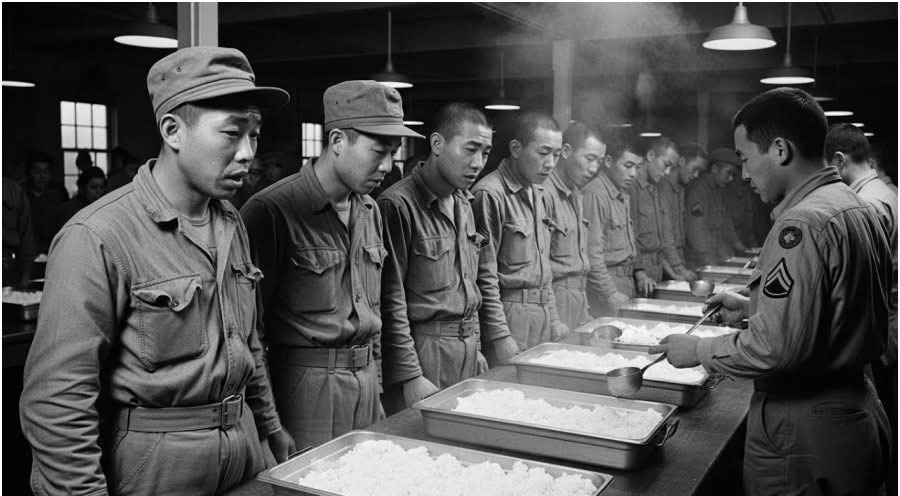
That evening, after the prisoners had been assigned to their bunks and given time to settle in, an announcement was made that dinner would be served in the mess hall.